zushi's place

animations

Utena

Theme spoiler warning: Revolutionary Girl Utena

Revolutionary Girl Utena is one of my personal favorite shows, and without spoiling the story content, one of the many interesting ways to read the theme of the show is how it suggests that the predominant thinking in society has been replaced from “kindness towards each other” to the toxic idea that “if you are stronger than others, then you will get your happily ever after”, whether that happily-ever after is through romance, reverting to an environment of idyllic childhood, or some other unfulfilled wish.

Though I have not considered that idea before, some of it resonates pretty deeply with me, I was reminded of this article about how ultra-rich people in the U.S. behave:

One thing Shteyngart noticed after spending time with this crowd was how competitive they were. “They’d compete against one another on their Bloomberg terminals all day and then at the end of the day they would play competitive poker with each other,” he says; this spirit of one-upmanship pervaded even the donations they made to charities. Shteyngart speculates that underneath this competitiveness is a need to seem smarter and more capable than their peers...

Shteyngart also witnessed the hedge funders making the sort of social comparisons that Norton and Harrington described, treating money as a “scorecard.” He remembers one of them saying something along the lines of “We don’t have best-seller lists and book awards. What we have is this—the number at the end of the day.”

It feels like there's this hedonic treadmill of status that people can't help but climb.

Looking at any form of mass media and studying any form of advertisements, it's really hard to escape the messaging that “success will bring you what you want” and that, if you are a girl, “attractiveness will bring you what you want”. While these certainly played a role even among other primate species, I suspect that their importance got severely exaggerated. The unfortunate part is that there may be a feedback loop – the more people are led to believe these things are important, the more people actually consider these things important, and now the chase for success or beauty can be rather suffocating.

Observing all of these phenomena, I definitely feel that this part of Utena's message have real-world applicability.

On the other hand, what about the show's proposed solution to the issue? The show's solution seems to just be “be kind and be genuine”, which, though both are things I try to be intentional about, doesn't feel like the whole answer somehow; though I fully concede that this may be a lack of personal growth in the area, and that the answer is intuitive to a lot of other people.

Somewhere out there, there's another system of emotions and personal values to be solved. Regardless, I really appreciate Utena the show for, among other important things, pointing out important problems like these about modern society.

— Categorized under: #theory, #sociology, #animations

Last year, I watched a little-known anime released in 2016 called Flip Flappers. The show is obscure for good reasons. There's an unusual amount of fanservice, the plot falls apart near the end, and most of the side characters come across as being very two-dimensional.

However, there was one aspect of the show that made a deep impression on me when I first saw it, and over the past few months, I have only come to appreciate that aspect of the show more and more. In this post, I want to capture this particular part of Flip Flappers that made it a special show for me.

Screen Shot 2021-02-01 at 12.02.52 PM

(This post will by necessity include some mild spoilers, but I will keep it as light as possible.)
Flip Flappers centers around the story of Cocona, a middle school student who is unable to decide the high school that she wants to attend. To her, this decision seem to have the potential to decide the rest of her life. However, all around her, other students seem unconcerned about their decisions – they seem to have decided quickly play and chat during as usual, and appear not to have given much thought to the issue.

Among these students, the upperclassman Iroha Irodori is an exception. She spends her lunch break on painting, and after class can be found in the art prep room (of which she is the sole maintainer of) drinking tea and working on more art pieces. Unlike the rest of the students at the school, Iroha is thoughtful, calm, and caring. Moreover, she possesses a distinct individuality that few in the school seems to have, and Cocona finds herself drawn to her in order understand where that individuality come from.

img

Over the course of the show, Cocona eventually comes to understand Iroha deeply, but it is not through the way that the she would have initially envisioned.

In Flip Flappers, Cocona has the ability to travel into fantasy worlds called Pure Illusions. These fantasy worlds are whimsical and abstract, much like the world of Alice in Wonderland. And unbeknownst to Cocona initially, these worlds are deeply connected to the people around her.

In the world where she eventually realizes this connection, Cocona comes to experience the life of a child named Iro through Iro's eyes. In that world, she discovers a gaping wound forming in the child's unhappy life. Unable to bear seeing that scar, Cocona works up the courage to exert her will on that world, and in doing so resolves the trauma that opened up. Though Iro still has a relatively sad childhood, at least Cocona made sure that it wouldn't be a scarring one.

image-20210201125600256

Of course, the child that Cocona helped turned out to be the past Iroha, and Cocona's excitement of helping the child became a rude awakening later on. When Cocona goes back to the art room after school, Iroha is no longer there. Looking around the school, Cocona finds the artist tossing out the old canvases that seem no longer need now. In their interactions, Iroha [no longer ]seem as thoughtful and reflective, but tends to projects her emotions spontaneously instead. Furthermore, she no longer spends her breaks painting, and has instead joined friends' conversations in the courtyard instead.

After Iroha's childhood trauma has been resolved, she has become a part of school's usual scenery of carefree students. It's scenery decidedly absent of that directedness and individuality that had once defined her and drawn Cocona to her.

And in what is unusual for a story like this, Iroha's character arc ends here. Flip Flappers does not comment on her character before or after the change, it does not attempt to have Cocona find and reclaim the old senpai. The Pure Illusion world is closed and gone, and there's no going back to the old Iroha. Cocona is left to consider the impact of her decisions on the world.

AMomentAgo2

I feel that in this handling of Iroha's arc, the show demonstrates an understanding of art, trauma, and people that I have seldom seen in other media. It understands that art is sometimes born from a desire to cope with a traumatic past, rather than from the strokes of brilliance that media usually portrays it as.

It also understands that trauma can be solely responsible for a person's positive identity, yet the person could still develop other positive identities otherwise.

It understands that sometimes, as a consequence of personal growth, valuable personality traits could be lost.

It understands that the dichotomy of individuality and conformity is much, much more nuanced than most popular media would give it credit for.

Lastly, it understands that the value judgement between an artist and a student is outside the scope of the show itself to comment on, and that the audience must reach their own conclusions on this one.

Despite being written and directed by artists in various mediums, Iroha's arc understands and portrays so many bitter truths about artists that I can't help but admire the grace and conviction with which it does so. It is a rare example of a show being incredibly honest and incredibly insightful, complimented by a combination of elegant and beautifully-illustrated storytelling. Flip Flappers is a diamond in the rough, but what diamond is there shines truly brightly.

Looking back, although I have mixed feelings about Flip Flappers, the recentness and the depth of the show gives me a lot of hope that the show will be surpassed on day. Both the screenwriter Yuniko Ayana and the director Kiyotaka Oshiyama are still in some ways up-and-coming names in animation, and I look forward to what valuable things they will say about art, trauma, and life in the future.

Categorized under: #animations, #psychology, #art, #essay

As I mentioned in an older post, I realized sometime this year that I require a minimum amount of narrative consumption to sleep well. This is something that no one else I know of deal with, but ended up being a net positive and a pretty large part of my life.

So I've watched a lot of animations this year. I've dabbled in watching more live-action shows (The Office, The Sopranos, The Queen's Gambit, various stand-up comedians) and feel like these are finally catching a bit of traction, but my main diet is still animation. Ended up finishing 12 series, 10 feature length animations, and have about 5 series ongoing so far. Here are the standouts of the year for me:

From the New World – a combination of sci-fi and fantasy with traditional Japanese elements and really thorough worldbuilding. This is a 26-episode anime series adapted from a book by a well-known mystery writer. From the New World details a civilization built from the ground up after an unexpected discovery in humans, and it observes this civilization from the perspective of six kids whose innocent childhood gradually gives way to a depressing understanding of human nature. What strikes me about this show beyond the worldbuilding is that it's a tragedy in the purest sense of the word – a tragedy on the scale of (multiple) individuals, societies, and even the entire human civilization. The strong worldbuilding means that there's a lot to think about specifically on the failures of societies and civilization here.

The directing of a few episodes were a bit strange, but for me it's more than made up by the aesthetic qualities of the plot and the sheer amount of things to think about from it. 10/10

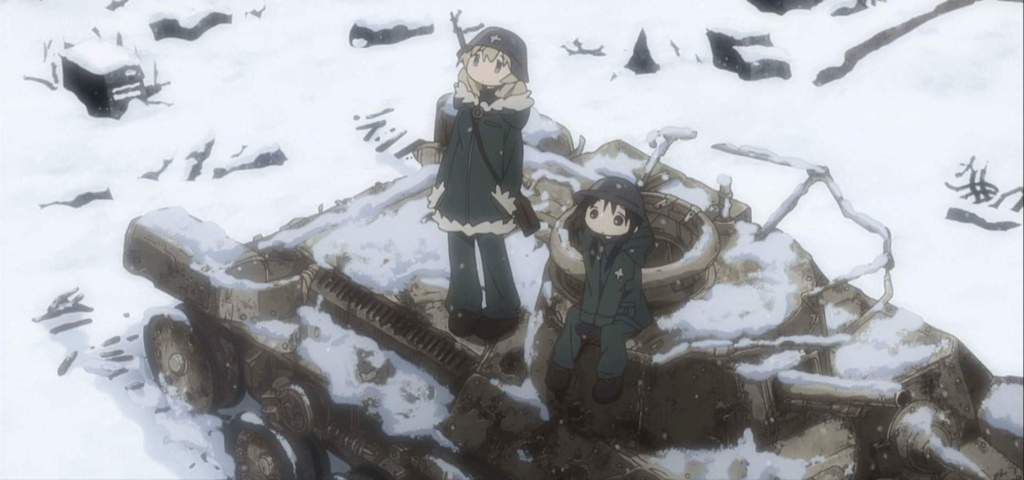
Girl's Last Tour – technically I'm one episode away from finishing this series, but I've been a huge fan of what I've seen so far.

Girl's Last Tour details two girls' travels through a post-war world with apparently few people remaining. The Girls have little knowledge of things we've taken for granted nowadays like music and religion, and so their conversations and discoveries throughout the show becomes a sort of philosophical investigation of modern life.

For what seems like a depressing setting, the show also does really well to keep it light. In fact, I would consider the overall mood of the show to be “comfy and relaxing”. It has the effect of having an effortless yet deep conversation with a close friend, interspersed with moments of humor and beauty. For me it's a 10/10.

Girl's Last Tour

I think retro nostalgia is back in a big way in 2020, and I guess my way of partaking in this has been watching Card Captor Sakura (1998) with friends on Discord. We had thought the show would probably be really boring since it's intended for audiences as young as elementary schoolers, but it ended up being surprisingly good at mixing a nice and sunny atmosphere with a variety of smart and funny unusual situations. It ended up being the perfect show for dealing with 2020. 9/10.

Lastly, Flip Flappers was really extreme in both its strength and flaws. It's one of the most creative, energetic, and visually appealing works I've seen, but got bogged down by loads of fanservice (wiki page) and a super-rushed ending, therefore, this is a show I wouldn't recommend to anyone unless I know that they really are not bothered by fanservice and am looking for something really out there. Neverthreless, I really appreciated it's surprisingly mature take on depression, and the show's appeal to a sense of adventure stayed with me a long time after it's over. For me this is among the most memorable show I've seen this year, but I would only give an 8/10.

On the other end of the spectrum, I've also seen some spectacularly bad animation this year that made me question faith in humanity. I may write about this in the future, but won't be disclosing the name for now.

That's it for this year! There are a ton of other good animations that didn't make the list, but I'd be happy to recommend shows in comments/conversations/DMs. Here's to encountering some really good animations next year.

— Categorized under: #animations