zushi's place

In 2020 I read ~30 books, which is roughly the same as 2019. Overall I really enjoyed what I've read, and here are some of the standouts from the year.

Good Reasons for Bad Feelings have been a really eye-opening tour the evolutionary forces behind emotions. Evolutionary biology feels really underrated by the general public. It's one of the only fields that supplies actual causes as opposed to proximate causes (or worse, just platitudes) for understanding emotions, and this book goes into rigorous detail on the actual causes of emotions, negative and positive. 10/10, would recommend to people who felt negative emotions at some point (or actually, feel them a bit more often than they would like).

I first read So Good They Can't Ignore You six years ago, and again about three years ago, so I guess my rereading of it this year falls into a general pattern. Despite actually disliking the book when I first read it, I've really come around to enjoying it. I think the book is quite original in pointing out weaknesses in the “follow your passion” vein of advice, and I've found the book's view of the job market to be one of the most clear out of anything career-related books I've read. I gave it a 9/10, only wishing for a bit more scientific rigor when it comes to presenting evidence.

I'm only halfway through The Mind Illuminated, a meditation guide with a program that takes a few month to years to go through. However, I'm already constantly amazed that this book even managed to exist. The author is an expert in both modern neuroscience and multiple ancient meditation traditions, which means that there's an anomalous amount of scientific rigor in a usually spiritual subject. Somehow, the book also manages to be excellent at teaching so far, which is completely baffling given that it would be extremely difficult to write about troubles experienced by beginning meditators from the perspective of an advanced meditator. Maybe I'll be more critical after I finish the book, but it feels like a tiny miracle so far, and I really like the fact that it talks about meditation in concrete terms, as opposed to vague spiritual ones.

The Left Hand of Darkness

The Left Hand of Darkness was the favorite fantasy book I've read this year, beating out the likes of Harry Potter, The Three Body Problem trilogy, and The Handmaid's Tale. Left Hand is a strange book to hold that distinction – it doesn't have surprising plot, nor hard sci-fi, and the setting isn't particularly appealing either. It's success is even surprising to its author:

Left Hand looked to me like a natural flop. Its style is not the journalistic one that was then standard in science fiction, its structure is complex, it moves slowly, and even if everybody in it is called he, it is not about men. That's a big dose of “hard lit,” heresy, and chutzpah, for a genre novel by a nobody in 1968.

What The Left Hand of Darkness does have is a deep understanding of a fundamental concept of human society:

The Gethenians do not see one another as men or women. This is almost impossible for our imaginations to accept. After all, what is the first question we ask about a newborn baby? ....there is no division of humanity into strong and weak halves, protected/protective. One is respected and judged only as a human being. You cannot cast a Gethenian in the role of Man or Woman, while adopting towards 'him' a corresponding role dependent on your expectations of the interactions between persons of the same or opposite sex. It is an appalling experience for a Terran.

The book explores that concept in a way that I'm not sure I've seen in media. In serious sci-fi and fantasy you can often categorize the writing as being a combination of sarcastic, critical, or cerebral. This book doesn't really read like that. It feels like the entire world, from the scope of civilizations to the scope of the most personal interactions were built from the ground up. The result was that at after the novel, I felt like I was rudely reawaken to a culture and a psychology dominated by the importance of gender. The book takes a bit getting into, but is a easy 10/10, and will probably be one of my favorite books of all time.

Categorized under: #reading

As I mentioned in an older post, I realized sometime this year that I require a minimum amount of narrative consumption to sleep well. This is something that no one else I know of deal with, but ended up being a net positive and a pretty large part of my life.

So I've watched a lot of animations this year. I've dabbled in watching more live-action shows (The Office, The Sopranos, The Queen's Gambit, various stand-up comedians) and feel like these are finally catching a bit of traction, but my main diet is still animation. Ended up finishing 12 series, 10 feature length animations, and have about 5 series ongoing so far. Here are the standouts of the year for me:

From the New World – a combination of sci-fi and fantasy with traditional Japanese elements and really thorough worldbuilding. This is a 26-episode anime series adapted from a book by a well-known mystery writer. From the New World details a civilization built from the ground up after an unexpected discovery in humans, and it observes this civilization from the perspective of six kids whose innocent childhood gradually gives way to a depressing understanding of human nature. What strikes me about this show beyond the worldbuilding is that it's a tragedy in the purest sense of the word – a tragedy on the scale of (multiple) individuals, societies, and even the entire human civilization. The strong worldbuilding means that there's a lot to think about specifically on the failures of societies and civilization here.

The directing of a few episodes were a bit strange, but for me it's more than made up by the aesthetic qualities of the plot and the sheer amount of things to think about from it. 10/10

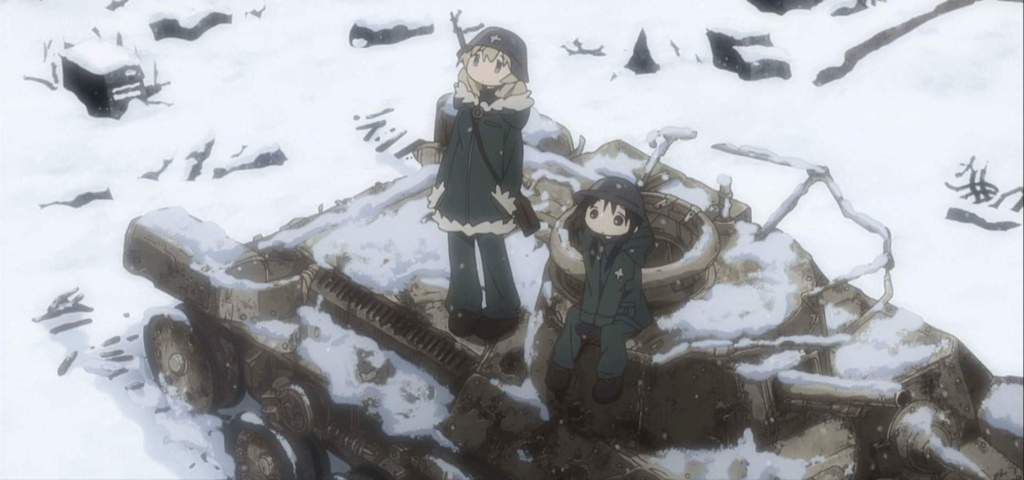
Girl's Last Tour – technically I'm one episode away from finishing this series, but I've been a huge fan of what I've seen so far.

Girl's Last Tour details two girls' travels through a post-war world with apparently few people remaining. The Girls have little knowledge of things we've taken for granted nowadays like music and religion, and so their conversations and discoveries throughout the show becomes a sort of philosophical investigation of modern life.

For what seems like a depressing setting, the show also does really well to keep it light. In fact, I would consider the overall mood of the show to be “comfy and relaxing”. It has the effect of having an effortless yet deep conversation with a close friend, interspersed with moments of humor and beauty. For me it's a 10/10.

Girl's Last Tour

I think retro nostalgia is back in a big way in 2020, and I guess my way of partaking in this has been watching Card Captor Sakura (1998) with friends on Discord. We had thought the show would probably be really boring since it's intended for audiences as young as elementary schoolers, but it ended up being surprisingly good at mixing a nice and sunny atmosphere with a variety of smart and funny unusual situations. It ended up being the perfect show for dealing with 2020. 9/10.

Lastly, Flip Flappers was really extreme in both its strength and flaws. It's one of the most creative, energetic, and visually appealing works I've seen, but got bogged down by loads of fanservice (wiki page) and a super-rushed ending, therefore, this is a show I wouldn't recommend to anyone unless I know that they really are not bothered by fanservice and am looking for something really out there. Neverthreless, I really appreciated it's surprisingly mature take on depression, and the show's appeal to a sense of adventure stayed with me a long time after it's over. For me this is among the most memorable show I've seen this year, but I would only give an 8/10.

On the other end of the spectrum, I've also seen some spectacularly bad animation this year that made me question faith in humanity. I may write about this in the future, but won't be disclosing the name for now.

That's it for this year! There are a ton of other good animations that didn't make the list, but I'd be happy to recommend shows in comments/conversations/DMs. Here's to encountering some really good animations next year.

— Categorized under: #animations

Was chatting with dad on the phone earlier today, and he mentioned that since he'd done so much (and done only) writing for academia and for his organization, he wanted to try writing with no particular goals in mind.

I think this is really appealing, and probably should apply to how I approach this blog as well. In general, having each article have to reach some sort of grand conclusion seem like a lot of hassle. And since this goal is created explicitly so that I could Write for no one else particular, it makes sense that I should sometimes, if not most of the time, write with no particular goals in mind.

Categorized under: #meta, #writing

Recently did a clear of an arcade game called Ketsui that I'm pretty happy about!

Ketsui is a top-down scrolling shooter where you play as a pair of pilots in an undercover U.N. mission to stop a global arms dealer called EVAC[1] Industries. The covert nature of the mission meant that, regardless of success or failure, the pilots must not return alive; so the premise is a bit tragic from the start.

Since it's release back in 2003, Ketsui has always had a niche following among bullet-hell gamers on account of its old-school roots combined with great pacing. It also has a notorious hidden boss that took arcade-goers years of practice to clear.

A few years ago, before emulations were a thing, I actually visited on a few remaining arcade venues that still has this game just to try it in person 😊

Structurally, the game is divided into 5 levels. The difficulty curve is quite interesting – stage 5 is extremely long and is harder than all the other levels combined. The music is peaceful here, which is striking compared against the chaos on the screen.

For the run itself, I messed up badly in stage 3 (died somewhere easy and missed a 1-up), but did really well from stage 4 onwards, and managed to beat it with one last ship in stock.

After beating stage 5, I got into the second loop, at the end of which you face the hidden boss. I don't have plans to clear this loop yet, so I ended up doing some commemorative save-states and accidentally scored a pretty humorous death.

I edited out two pauses to answer some IMs during the session, was planning to edit out the wallpaper too, but I ended up liking it as framing and kept it in.


[1]: a tongue-in-cheek reference to the game's developer, CAVE.

Categorized under: #gaming

(Editor's note: this is a migration of a post from late March of this year.)

Did a no death clear of Samidare's Extra Stage!

Samidare (Lit. Early Sumer Rain) is an indie top-down shooter game released in 2002 for Windows.

Around 2002, a student club in Tokyo created a variety of top-down shooter series. One was the Touhou (“Oriental”) Project, one was the Seihou (“Occidental”) Project, and the last one was Project Blank. Each project had multiple sequels, with Seihou taking inspiration from Touhou, and Project Blank taking inspiration from both.

Samidare is the first Project Blank game. It has a shield system that allows the player to absorb projectiles to boost firepower. The shield meter regenerates slowly, and most of the gameplay is centered around managing limited shield uses.

I like Samidare a lot – you can tell it's a labor of love. The gameplay and the soundtrack are both excellent, the crossovers with Touhou and Seihou are really well done, and the unlockable Extra stage showed the kind of attacks possible only with the shield system.

Most importantly, the game made me feel like that the student club really had a good time back then.

Anyways, I dug up this old game recently, and thought that I should give it a proper sendoff. The last time I played it was 13(!) years ago, and amazingly I still remembered the extra stage pretty well. Back then I was pretty happy just to be able to beat it, but the no-death challenge felt manageable this time around.

Note: as with most modern shooters, the player's hitbox is really small. In Samidare it's the red square on the player ship, and the shield meter is on the bottom left corner.

Enjoy!

Categorized under: #gaming

I recently made a separate blog called looking through the window. It's intended for entries that are less personal.

In general there seems to be two distinct types of things I like to write about. On one hand there's journal entries and personal updates, and on the other hand there's serious essays. However, these two types of posts tend to have pretty distinct audiences, so it made sense to sperate them out.

I think is will be a good change. Usually, after a change, there's a small period of discomfort before getting used to a new setup. In this case though, both places feel more comfortable to me already.

— Categorized under: #meta

20191222_121025

One of the interesting things about dreams are how different people experience them differently. I have some friends who would often have vidid or epic dreams, and have others friends who barely dream at all. It seems to me that if I squint hard enough, I could see some personality differences between those groups, but since the sample size is small, it's pretty hard to generalize.

I personally sit somewhere in the middle of that spectrum, which doesn't come as a surprise. However, I seem to have some other patterns regarding dreaming that others don't share.

In particular, there is a really strong three-way correlation between the amount of stories I've seen in a day, the amount of dreams that I have, and the quality of sleep I get.


Those who know me pretty well know that I'm pretty into fiction and animations, what they might not know is that these activities are backed by unexpectedly pragmatic motivations – I find that if I don't expose myself to some sort of new story during the day, I will often get less sleep. Without the dreamlike headspace inspired by stories, I would often find it hard to stay asleep.

It's as if the train I'm on had ran out of fuel and stopped dead in its tracks, and the driver could only throw up his hands like “well, I can't really do much about it, can I?”


When I ask others about the relationship between stories and sleep, I usually get this blank stare or something to the tune of “I haven't really thought about it?”, which is pretty surprising.

My theory along this line is that others tend to subconsciously fulfill their need for stories. E.g., they tend to often “feel like” that they wanted to watch a show or read a story, or just default to those activities. Whereas for me, after a certain age, I started to rarely “feel like” watching a show or reading a story, and don't really default to those activities either. As a result, I sometimes go to bed without getting my fill of stories for the day, and this made it easier to correlate sleep and stories over time.

Growing up, I was a pretty voracious reader of fiction, usually finishing a book every two or three days. What caused me to lose touch with the need for stories? I'm not quite sure. Perhaps after life started getting busy in college, story time became the first luxury to be cut. Eventually, when life went back to a less frantic state, I started to realize that narratives contribute to my well-being in an indirect way.


Over time, I started experimenting about what kind of things fuel dreams for me. At the beginning I thought that it would be “new experiences”, but stories seem to most consistently form dreams for me. For example, new music or engaging conversations don't really improve my sleep much, but first-time experiences of movies, shows, or books certainly do it. Having an eventful day in real life seems to work too.

When I have more time, I would like to try and see whether art and various documentaries do anything; but for now, the overarching rule for now seems to be that “if it's something you can tell someone else a story about” then it's good enough to generate dreams.


All this raises more questions than answers. Why do I need narratives? Where do those stories go after they become dreams? Do they somehow become a deeper part of myself, beyond the superficial imprint on my memories? If so, what sort of effect do they have on what I do?

To the extent that one can have answers to these types of questions, I don't really have any good ones as of yet But I'm super curious about what that process is like, and look forward to finding out someday.

Categorized under: #irl, #psychology

Early this year, I started rating my days on a scale of 0-10 on various metrics. The one I've been keeping watch the most on was the one labelled “Be Happy”.

Just this week I got a pretty good score...

image-20200921224940700

It's actually a perfect score.

It's not that something really good happened that week, or that things went perfectly well. I actually didn't sleep well for a few days, and felt a bit behind on work for most of it. Regardless, at the end of each day that week I could honestly say that the day went pretty well and put down a 10 for it.

This leads to some interesting questions – for example, what does a 10/10 mean, if I could imagine a hypothetical future that would be “happier”? Would it be worth going down to 8 or even 9, if it means getting everything I think I would want? Some things to think about in the coming weeks.

Also, a side effect of this result means that I have to be emotionally prepared now, since it can only go downhill from here 😅


~🥂~

Categorized under: #irl

The other day I was excitedly telling my friend about how I started blogging, and was in the middle of it when he landed this blow:

“So... do you feel like you don't have enough people to have deep conversations with in real life?”

Ouch, I felt that one. Now I feel compelled to self-analyze.

Thinking about it, if I were able to talk about everything to someone, I would probably blog a bit less. There is a component of blogging for me that's like “shouting into the void”, where I just kind of say things on my mind, and it probably wasn't a coincidence that I started blogging more during quarantine.

On the other hand, I don't really think that's the entire point. Looking at blogging purely that way is a bit similar to “lol, aren't diaries just substitutes for human interaction” and “lol, wasn't Henry David Thoreau just writing because he got angsty in the woods”, which just sounds a bit silly. Writing arises out of a varied list motivations and instincts, a lot of which are either intuitive to the writer or become obvious after some thinking. For me, it didn't end up taking that long to realize that I'll always end up doing some form of blogging, both for writing and for the fun and the comfort of designing one.

Not to misrepresent my friend's question, though. It's a good one to ask regardless, and has been surprisingly useful in thinking about my reasons for blogging.

Categorized under: #irl, #writing

Music I'm listening to a lot recently:

Crypt of the Necrodancer Soundtrack (Genre: dance, electronic)


“Stars Falling on Tema's Mountain” (Touhou 18, Stage 5 Boss Theme) (Genre: electronic)


“Lunar Rainbow” (Touhou 18, Stage 6 Theme) (Genre: electronic)

Enter your email to subscribe to updates.